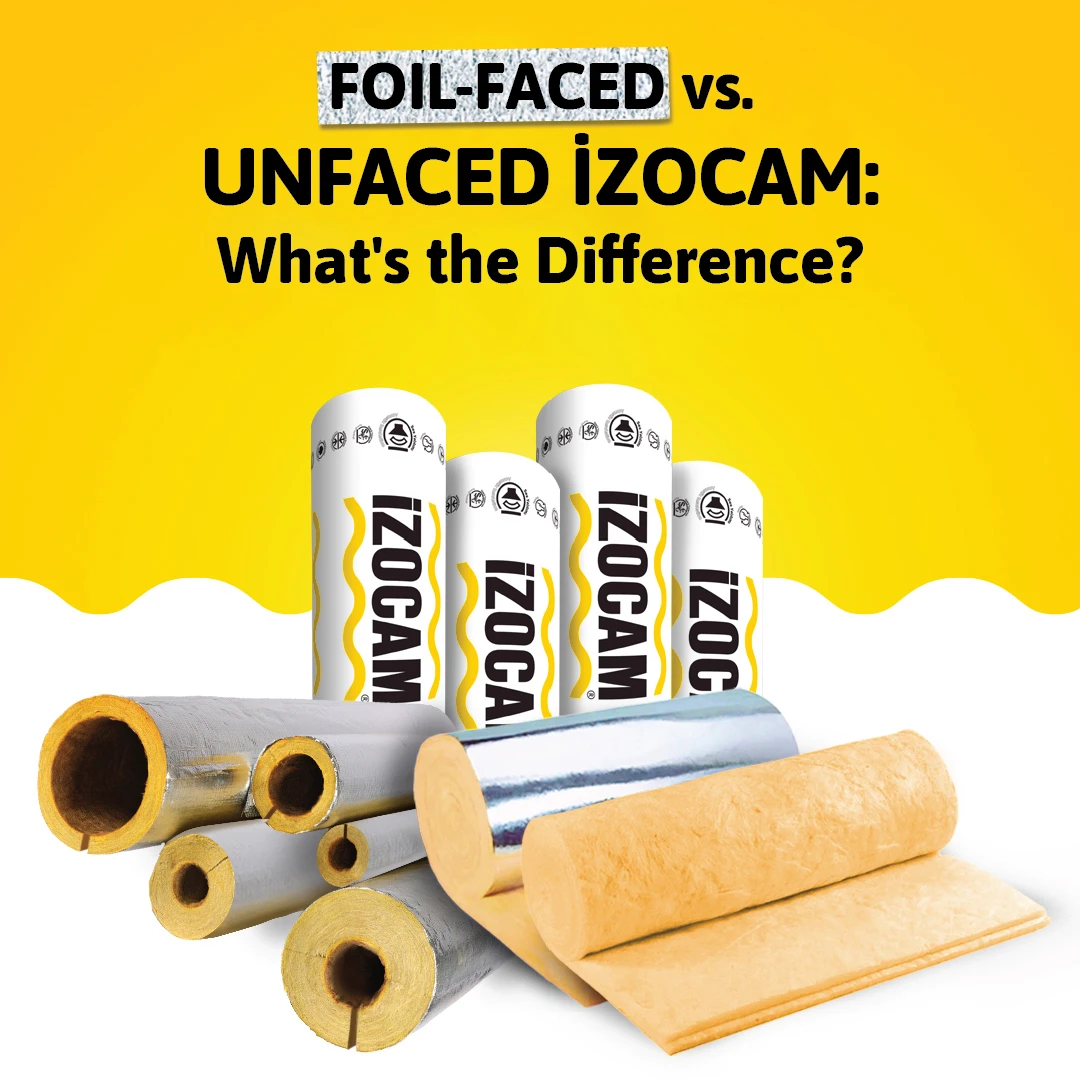
Insulation materials vary in their properties depending on application areas and required performance criteria. The two insulation materials, foil-faced İzocam and unfaced İzocam, differ particularly in terms of vapor permeability and application areas.
Where aluminum foil-faced glass wool or stone wool is used, the aluminum foil surface limits vapor diffusion, thereby reducing the risk of condensation and providing a more durable exterior surface.
Since glass wool provides both heat and sound insulation, it is particularly preferred for ventilation ducts, attics, and partition walls. It provides acoustic comfort thanks to its high sound absorption capacity. It is also resistant to a wide temperature range, allowing for equally broad application.
Stone wool, on the other hand, stands out for its higher heat resistance and structural durability. It is safe for use in insulating industrial facilities, boilers, pipes, and equipment.
Aluminum faced-products should be installed with the aluminum facing outward. That will ensure both moisture control and heat insulation. Unfaced products, on the other hand, are preferred in areas with low vapor diffusion. The correct product form, whether board, blanket, or pipe section, ensures long-term and effective insulation.
İzocam İzopan products, which are rigid glass wool boards faced with aluminum foil on one side and yellow glass tissue on the other, are used behind heat sources such as radiators, stoves, and ovens to reflect and retain heat.
İzocam glass wool blankets used in attics, on the other hand, should be installed with the aluminum foil-faced surface facing the heated area. If the attic is neither used nor heated, the insulation material can simply be laid on the floor. In that case, the aluminum facing should be oriented downward toward the flooring.
If the blanket is laid with the foil side facing up, the aluminum layer will block vapor diffusion. When warm vapor meets the cold air in the attic, it can condense into water and, unable to pass through the foil, may be absorbed into the insulation material. That can cause the material to deteriorate without any external influence.
If you are in a building with a heated or used attic, the insulation is applied to the attic roof. In that case, the aluminum facing should be oriented toward the interior of the attic.
İzocam glass wool prefabricated pipes are used for the thermal insulation of industrial pipes, radiator pipes, central heating systems, and solar power installations. They are also used to insulate pipes against condensation and freezing. In addition, they provide resistance to vibration and noise in pressurized water pipes.
Foil-faced or unfaced İzocam stone wool prefabricated pipes, on the other hand, provide reliable and durable insulation for industrial piping, outdoor anti-freeze lines, and systems exposed to pressure. Depending on the required service temperature, either glass wool or stone wool prefabricated pipes may be preferred for industrial pipe insulation.
To choose between foil-faced or unfaced İzocam products, it is necessary to assess factors such as condensation risk, temperature levels, acoustic requirements, and outdoor exposure at the application site.
The correct product selection and application will significantly improve energy efficiency and ensure long-lasting, reliable insulation.


